Asian Garden Ideas: How to Design a Calm Backyard Retreat
Somewhere between the stone path and the sound of trickling water, an Asian garden does something most backyards never manage. It slows you down. You step outside for two minutes and forget you had anywhere else to be.
That feeling is not an accident. It comes from a handful of design choices that have been refined for centuries in Japan, China, and other parts of Asia. The good news is that you do not need acres of land or a professional crew to bring that same calm into your own yard. This article walks you through how to do it, from picking the right style to choosing plants that will not die on you by August.
What Makes a Garden “Asian” in the First Place?
The term Asian garden covers several distinct traditions, but they share a few common goals. Every one of them tries to create a small, believable slice of nature rather than a showy display of flowers. Water, stone, and carefully shaped plants work together instead of competing for attention.
There is also a strong focus on restraint. A Western flower bed often tries to pack in as much color as possible. An Asian garden usually does the opposite. It uses a narrow color palette, mostly green, and lets texture and shape carry the design. Less really is more here.
The Four Elements Every Asian Garden Needs
You do not need every single feature below to get the look right, but a real Asian garden almost always includes some version of these four building blocks.
1. Water
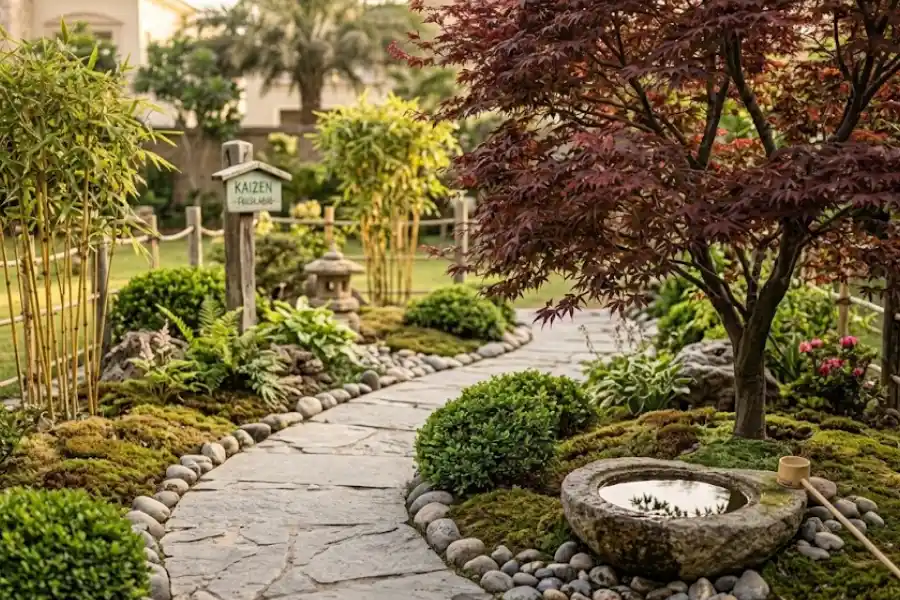
Water represents life and movement, and it is often the first thing people notice. This can be a small pond, a trickling fountain, or even a bamboo shishi-odoshi that taps against a rock every few seconds. A simple bubbling urn fountain from a garden center can do the job for under two hundred dollars, and it is often enough to cover street noise from a busy road.
2. Stone
Rocks and gravel act as the bones of the garden, and a bed built around river rock landscaping is one of the simplest ways to get that layered, natural look without much upkeep. In many designs, large stones are placed first, almost like furniture, and everything else is arranged around them. Raked gravel is sometimes used to represent flowing water, especially in a Japanese dry garden, also called a karesansui.
3. Plants
Plant choice matters more than plant quantity. Evergreens, layered foliage, and a few specimen trees do far more work than a wide mix of flowering annuals. We will cover exact plant picks in the next section.
4. Framework and Enclosure
A wooden gate, a bamboo fence, a small bridge, or a stone lantern gives the eye a place to rest. Many Asian gardens are also enclosed, whether by a living wall of shrubs or an actual fence, which helps the space feel private and separate from the rest of the yard.
Japanese, Chinese, or Balinese: Which Style Fits Your Yard?
Most articles lump every Asian garden style into one bucket, but the traditions are genuinely different, and picking the right one will save you money and frustration.
- Japanese gardens lean minimal and quiet. Expect raked gravel, moss, a single striking maple tree, and very restrained planting. This style suits small yards best because it does not need much square footage to feel complete.
- Chinese gardens are built more for gathering with family and friends. Layouts tend to be more open, water features are larger, and there is more architecture, such as pavilions or covered walkways. This style needs more space to breathe.
- Balinese gardens feel tropical and lush, with dense greenery, stone carvings, and water that often includes floating lotus flowers. This works well in warmer climates like Florida, Southern California, or the Gulf Coast, but it is harder to pull off if you live somewhere with hard winters.
If you are only picking one thing from this list, pick your style before you buy a single plant. Mixing all three at once is the single fastest way to make a yard look cluttered instead of calm.
Best Plants for an Asian Garden
Plant choice is where a lot of these gardens go wrong. People buy whatever looks pretty at the nursery instead of choosing plants that fit the style and the climate. Here is a solid starting list, organized by role.
Trees and Focal Plants
- Japanese maple (many varieties stay under 15 feet tall, perfect for small yards)
- Dwarf mugo pine
- Ginkgo tree
- Flowering cherry
Shrubs and Greenery
- Boxwood, kept clipped into soft rounded shapes
- Clumping bamboo (avoid running bamboo unless it is contained, or it will spread into your neighbor’s yard)
- Camellia
- Nandina for a splash of red without breaking the green color scheme
Ground Cover and Moss
- Irish moss or Scotch moss between stepping stones
- Mondo grass along path edges
- Ferns and other shade-loving plants in shaded corners
A quick rule that landscapers often repeat: choose plants based on their shape and leaf texture first, and their flowers second. White flowers, in particular, are usually avoided in traditional Asian garden design because they tend to read as too bold against the quiet green backdrop.
How to Build an Asian Garden on a Small Budget
You do not need thousands of dollars to get this look right. Here is a straightforward order of operations that keeps costs down and avoids wasted work.
- Pick one small corner first. A four-foot by six-foot area near a window or patio is plenty to start. You can expand later once you know what works.
- Lay your stone path before you plant anything. Decide where people will walk, then set flat stepping stones with gaps for moss or gravel.
- Add one large rock as your anchor. Even a single half-buried boulder gives the space shape instantly.
- Plant your tallest piece next. A single Japanese maple or dwarf pine becomes the visual center of the whole garden.
- Fill in with two or three shrub types, no more. Repeat them in small groups rather than scattering one of everything.
- Finish with a small water feature. A basic solar-powered fountain kit can cost less than a dinner out and still deliver that calming sound.
A garden built with three plant types and one good rock will almost always look more finished than a garden built with fifteen plant types and no plan.
5 Mistakes That Ruin an Asian Garden
Most articles skip this part, but knowing what not to do saves the most time and money.
- Using too many colors. Bright annual flowers fight with the calm, green-heavy palette this style depends on.
- Choosing running bamboo without a barrier. It spreads fast through underground roots and can take over an entire yard within a couple of seasons.
- Skipping the path. A garden without a clear walking route feels flat, no matter how nice the plants are.
- Overcrowding the space. Empty space, sometimes called negative space, is part of the design, not a gap to fill.
- Copying a style that does not match your climate. A Balinese-style tropical garden will struggle to survive a cold Midwest winter without serious extra work.
Keeping It Low-Maintenance
One reason people fall in love with this style is that it can be far easier to maintain than a typical flower garden once it is established. Evergreens do not need replanting every year. Gravel does not need mowing. Moss barely needs anything beyond shade and moisture.
The main upkeep tasks are light pruning to keep shrubs in their soft, rounded shapes, occasional raking if you use a gravel area, and keeping an eye on any running plants like bamboo so they stay where you put them.
Frequently Asked Questions
How much does an Asian garden cost to build?
A small DIY corner can cost as little as a few hundred dollars for stone, plants, and a basic fountain. A full professional installation with a pond, pathways, and mature trees can run into the thousands, depending on your yard size and location.
What is the difference between a Zen garden and an Asian garden?
A Zen garden is one specific type of Japanese garden, usually a dry rock garden with raked gravel and very few plants. “Asian garden” is a much broader term that also includes Chinese, Balinese, and other lush, planted styles.
Can I create an Asian garden in a small yard or on a patio?
Yes. In fact, a minimal Japanese-inspired style often works better in tight spaces than in large ones, since it relies on a few well-placed elements rather than sprawling space.
What plants should I avoid in an Asian garden?
Running bamboo without a root barrier, brightly colored annual flowers, and plants with white blooms are usually skipped, since they clash with the traditional green, calm color scheme.
Do I need a water feature for it to count as an Asian garden?
It helps a lot, but it is not required. If a pond or fountain is not possible, a stone basin filled with still water or even a dry gravel “stream” can suggest the same idea.