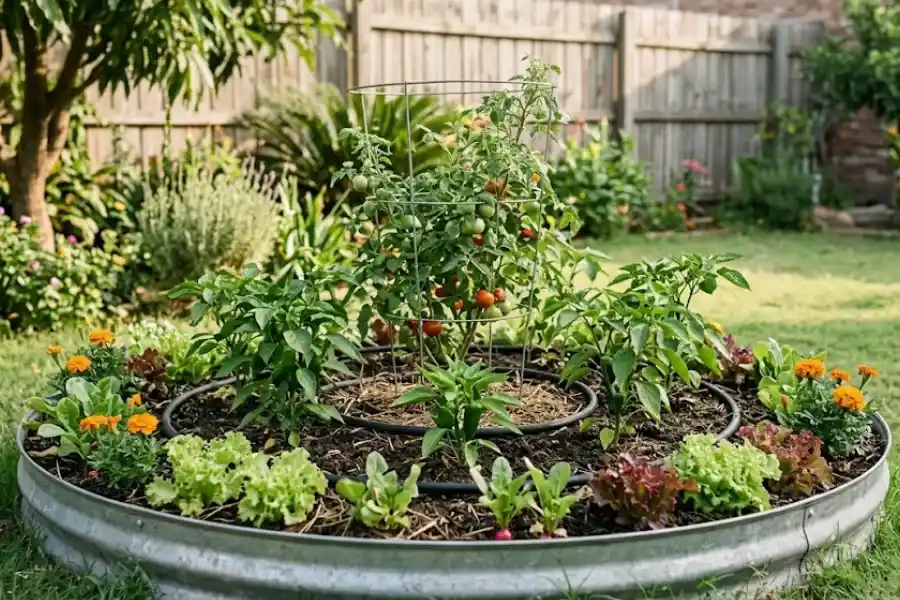
Round Garden Bed: Best Size, Soil, and Plant Layout
A round garden bed looks great. It also grows great food and flowers. But most people get the size wrong on their first try, and that one small error can ruin the whole bed.
This article helps you avoid that. Below, you will find how big to make your bed, how much soil to buy, what to plant where, and which mistakes to skip. Everything is in plain words, so you can start this weekend.
Quick answer: For most people, the best round garden bed is about 4 feet wide and 12 inches deep. You can reach every plant from the outside, and it holds about 12.6 cubic feet of soil.
Why Choose a Round Garden Bed?
Square beds are common. So why pick a circle? Here are the real benefits.
- It softens your yard. Straight lines can feel stiff. A circle adds a gentle curve and gives the eye a place to rest.
- It becomes a focal point. Place one in the middle of a lawn or at the end of a path, and people notice it.
- It is easy to reach. Every plant sits close to the edge, so you can weed and pick without stepping on the soil.
- It fits small spaces. A small circle works on a patio, a balcony, or a tight corner.
- It can be moved. Many metal kits are light, so you can empty one and set it up somewhere new.
There are a few downsides to a round garden bed too. A circle leaves small gaps at the corners of a yard. It is harder to build from wood, because boards are straight. And you cannot plant in neat rows. These problems are small, but it helps to know them before you buy or build.
How Big Should a Round Garden Bed Be?
Size is the most important choice you will make. Get it right and everything else gets easier.
The rule is simple: you should be able to reach the center without stepping inside. Most adults can reach about 2 feet. A round garden bed that is 4 feet across is a safe pick, because no plant is more than 2 feet from the edge.
Here is a quick size chart:
- 2 to 3 feet wide: Great for herbs, lettuce, strawberries, or a single tomato plant. Good for patios and balconies.
- 4 feet wide: The best all-round size. There is room for a mix of vegetables and flowers.
- 5 to 6 feet wide: Fine if you add a stepping stone in the center or leave a small gap in the ring so you can step in.
- Wider than 6 feet: Hard to care for. Build two smaller beds instead.
Depth matters too. Lettuce, herbs, and radishes are happy with 8 to 12 inches of soil. Tomatoes, peppers, carrots, and potatoes like 12 to 18 inches. If the ground under your bed is rocky or hard, make the bed taller.
Where to Put Your Round Garden Bed
A good spot saves you years of trouble. Check these four things before you buy anything.
- Sun. Most vegetables need 6 to 8 hours of direct sun each day. Watch your yard for a full day to see where the light falls. Leafy greens and many herbs can handle a little less.
- Water. Place the bed within reach of a hose. Carrying cans gets old fast.
- Flat ground. A slope makes soil slide and water run off. Level the spot first.
- Distance from trees. Tree roots steal water and food. Keep your bed well away from large trees.
Also think about where you will walk. Leave at least 2 feet of space around the bed. If you want to use a wheelbarrow, leave 3 feet.
Best Materials for a Round Garden Bed
Galvanized Steel Kits
Steel kits are the easiest way to get a round garden bed. The panels bend into a ring, and many kits go together in under an hour with basic tools. They do not rot, and they last for years. Prices vary a lot, from about $30 for tiny kits to well over $150 for tall, thick ones. One tip: metal walls can get warm in hot summers. If you live in a hot area, mulch the soil and water a little more often.
Wood
Wood gives a warm, natural look. Because boards are straight, most people use many short boards or flexible strips to make the curve. Cedar resists rot best. If you build with wood, a garden bed liner can also keep wet soil off the boards. Avoid old railroad ties, because they may leak chemicals into your soil.
Stone, Brick, and Concrete Blocks
These look classic and can last for decades. Curved landscape blocks make a perfect circle easy to build. They cost more and need a flat, firm base. A wide stone top can even work as a seat. On a smaller budget, plain concrete blocks can form a ring too, and these cinder block garden ideas show a few ways to use them.
How to Build a Round Garden Bed in 7 Steps
- Mark the center. Push a stake into the ground where you want the middle of the bed.
- Draw the circle. Tie a string to the stake. Make the string as long as half the width of your bed. For a 4-foot bed, use 2 feet. Keep the string tight and walk around the stake, marking the ground with flour, sand, or spray paint. A tight string keeps your circle round and stops it from turning into an egg.
- Clear the ground. Remove the grass and weeds. Or skip the digging: lay plain cardboard over the grass and wet it well. It will break down over time.
- Loosen the soil. Use a garden fork to break up hard ground so roots can reach down.
- Set the walls. Place your ring on the line. Use a level to check that it sits flat, and adjust the ground until it does.
- Block pests if needed. If gophers or moles live nearby, lay wire mesh (often called hardware cloth) on the ground before you fill the bed.
- Fill with soil. Add your soil mix, water it well, and let it settle for a day. Then top it up. The next section shows how much you need.
How Much Soil Does a Round Garden Bed Need?
Many articles skip this part, and it is where people waste money. Here is the easy math for your round garden bed.
Use this formula: 3.14 × radius × radius × depth. The radius is half the width. Measure everything in feet.
For example, take a bed that is 4 feet wide and 1 foot deep. The radius is 2 feet. So the math is 3.14 × 2 × 2 × 1, which is about 12.6 cubic feet. That equals about half a cubic yard. In bags, that is roughly 6 to 8, depending on bag size.
Here are quick numbers for a depth of 12 inches:
- 3 feet wide: about 7 cubic feet
- 4 feet wide: about 12.6 cubic feet
- 6 feet wide: about 28 cubic feet, just over 1 cubic yard
For larger beds, bulk soil from a local supplier is often cheaper than bags. To plan edging, multiply the width by 3.14. A 4-foot bed needs about 12.6 feet of edge.
What should the soil be? A good mix is about 60 percent topsoil, 30 percent compost, and 10 percent light material like perlite or coarse sand. You can also buy a bagged raised bed mix. Do not fill the bed with plain garden dirt alone, because it packs down hard.
Best Plant Layout for a Round Garden Bed
A round garden bed works best when you plant in rings, like a target. Put tall plants in the center, medium plants in the middle ring, and low plants on the outside.
- Center: Tomatoes in a cage, pole beans on a small teepee, or sunflowers.
- Middle ring: Peppers, bush beans, kale, or bush cucumbers.
- Outer ring: Lettuce, radishes, thyme, strawberries, and marigolds that spill over the edge.
One warning: a tall plant in the middle casts shade on its neighbors. Pick slim plants, like beans on a narrow teepee. Or place the tallest plants on the north side, so they do not block the sun from the rest. Have a rectangle bed as well? Our 4×8 raised garden bed planting layout shows how to space plants in that shape.
Your plant choices also depend on climate. Check your zone on the USDA Plant Hardiness Zone Map before you buy flowers and perennial herbs.
Idea 1: The Salad Bed
Plant a cherry tomato in the center. Add peppers in the middle ring. Fill the outer ring with lettuce, radishes, and chives. You can make a fresh salad without leaving your yard.
Idea 2: The Herb Bed
Put a tall herb like dill in the center. Add basil and parsley around it. Finish with thyme, oregano, and chives on the edge. Mint spreads fast, so grow it in a pot buried in the soil.
Idea 3: The Pollinator Bed
Plant sunflowers or tall zinnias in the center. Add coneflowers and bee balm in the middle ring. Fill the edge with sweet alyssum and marigolds. Bees and butterflies will find it quickly. For more flower picks and layouts, check these butterfly garden design plans.
Watering and Care Tips
- Water at the base. Early morning is best. A soaker hose laid in a spiral works very well in a circle.
- Test before you water. Push a finger 1 inch into the soil. If it feels dry, water. If it feels damp, wait.
- Add mulch. Spread 2 to 3 inches of straw or wood chips. It holds water and blocks weeds.
- Feed the soil. Add a layer of compost each spring. Soil sinks over time, so top it up once a year.
- Rotate your crops. Do not grow the same vegetable in the same spot every year. It helps cut down on pests and disease.
5 Common Round Garden Bed Mistakes
- Making it too wide. If you cannot reach the center, you will step on the soil and pack it down. Stay at 4 feet for easy care.
- Skipping the level check. A tilted bed drains unevenly. One side floods while the other dries out.
- Crowding the plants. Seed packets list spacing for a reason. Crowded plants fight for light and get sick more easily.
- Choosing a shady spot. Vegetables that get too little sun grow slowly and give small harvests.
- Using poor soil. Cheap fill soil hurts your plants all season. Good soil is the best money you will spend.
Frequently Asked Questions
What is the best size for a round garden bed?
Four feet across is best for most gardeners. You can reach the center from any side, and there is enough room for a mix of plants.
How tall should a round raised garden bed be?
Aim for 12 inches. That is enough for most vegetables and flowers. Use 8 inches for lettuce and herbs, and 18 inches for carrots and potatoes.
Can I put a round garden bed on grass?
Yes. Lay plain cardboard over the grass, wet it, and set your bed on top. Then fill it with soil. The grass underneath will slowly die and break down.
Is a metal round garden bed safe for vegetables?
Many gardeners use galvanized steel for food without problems. If you want extra peace of mind, choose a kit sold for edible gardens and ask your local extension office for advice.
Does a round garden bed need a bottom?
Usually not. An open bottom lets roots grow farther down and water drain. Use a closed bottom only on a patio or balcony, where the bed sits on a hard surface.
What grows best in a round garden bed?
Almost anything small to medium does well. Lettuce, herbs, tomatoes, peppers, beans, strawberries, and many flowers are great picks.
Final Thoughts
A round garden bed is one of the easiest ways to make a yard look better and grow your own food. Keep it about 4 feet wide, put it in a sunny spot, fill it with rich soil, and plant in rings. Do that, and you avoid the biggest mistakes.
Start small. You can always add a second bed next season.