10×12 Outdoor Retractable Pergola Canopy: 9 Checks Before You Buy
A 10×12 retractable pergola looks like a great deal. The photos show a cozy patio, soft shade, and a happy family. The price is often under $300.
Then the box arrives, and the questions start. Is the canopy really waterproof? Will the frame shake in the wind? Do you need a permit?
This article answers those questions in plain words. By the end, you will know how to pick the right size, frame, and canopy. You will also know how to set it up so it stays put. The short answer comes first.
Quick answer: A 10×12 retractable pergola is a smart buy if you want adjustable shade over a patio, deck, or garden for about $260 to $500. It gives shade, but it is not a roof. Choose a rust-resistant metal frame, anchor it to a hard surface, and close the canopy before storms.
What Is a 10×12 Retractable Pergola?
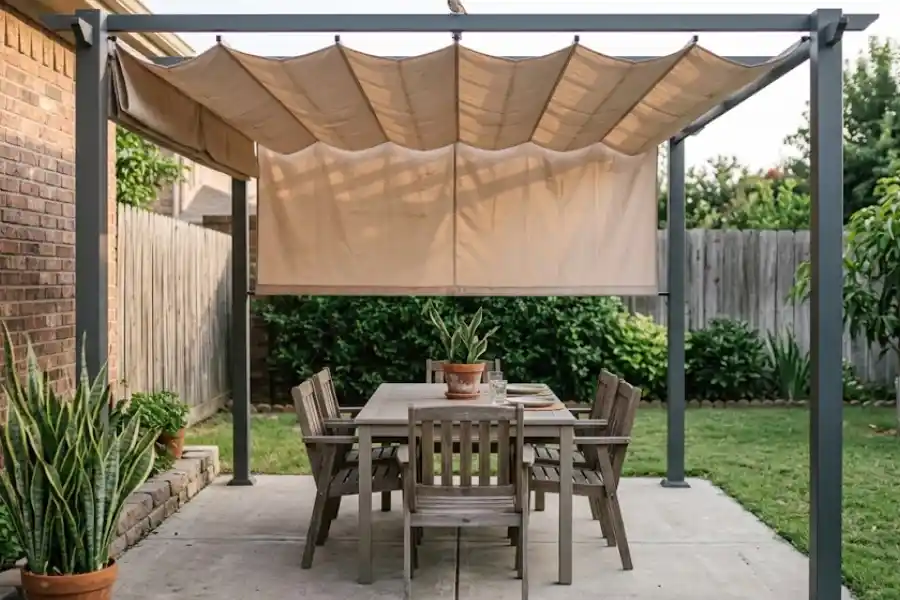
A 10×12 retractable pergola is a metal frame with a sliding fabric roof. The frame covers 120 square feet. You pull the canopy open for shade. You slide it back when you want sun or a view of the stars.
Sellers use many names for this one product. You may see it listed as a 10×10/10×12 outdoor retractable pergola canopy patio metal garden gazebo. Other listings say “grape trellis,” “sun shelter,” or “pergola gazebo.” They all mean nearly the same thing: posts, rails, and a fabric canopy that moves.
It is not the same as a hardtop gazebo. A hardtop gazebo has a solid roof that never moves. A louvered pergola has slats that tilt open and shut. Both cost more and handle rain better. A retractable pergola canopy is the lighter and cheaper choice.
Who Should Buy One (and Who Should Skip It)
A 10×12 retractable pergola is a good fit if you:
- Want shade over a dining set or lounge area
- Like to control how much sun comes in
- Have a flat patio, deck, or concrete pad
- Are on a budget and can handle a weekend of assembly
You should skip it, or look at a hardtop or louvered model, if you:
- Need a dry space in heavy rain every week
- Live where strong winds or heavy snow are common
- Want a fixed setup you never have to adjust
1. Check the Real Size, Not Just the Title
The title says 10×12. The real frame may be a little different. One popular 12 by 10 foot listing shows total dimensions of about 11.8 feet long, 10 feet wide, and 7.2 feet tall. Always read the “dimensions” line in the product details.
The two common sizes compare like this:
- 10×10: 100 square feet. Good for a small sectional or a four-seat dining set.
- 10×12: 120 square feet. That is 20 more square feet, which is enough to change how the space feels.
Also check the height. Many models stand about 7 to 8 feet tall. One review roundup noted short headroom for tall people on a similar model. If someone in your home is over six feet, look at the post height before you buy.
2. Pick the Right Frame: Aluminum or Steel
The word “metal” in a listing tells you very little. Dig into the details and find out if the frame is aluminum or steel. Both usually have a powder-coated finish.
Aluminum frames
- Do not rust
- Lighter, so they are easier to carry and set up
- Often cost a bit more
- Can feel less stiff on wide spans
Steel frames
- Stiffer and sturdier on wide spans
- Often cheaper
- Can rust where the coating chips or scratches
- Heavier to move
If you pick steel, keep a small can of outdoor touch-up paint nearby. Fix chips right away. For aluminum, look at the post thickness. Thicker posts usually feel more solid. One review site praised 3.5-inch posts on a larger model.
Also look for pre-drilled feet on the posts. They let you bolt the frame down. That matters a lot, and we will get to it soon.
3. Look Closely at the Canopy
The canopy is the part that wears out first. It is also where most buyers get surprised.
Many listings say “waterproof.” Some owners say the canopy leaks or drips in real rain. Others report water pooling in low spots between the rails. That water can stretch the fabric over time. One maker even says to avoid using the canopy in strong wind, heavy rain, or snow.
So treat the canopy as rain-resistant shade, not a roof. Look for these things:
- Coated fabric: Look for PA or PU coating on yarn-dyed polyester. The coating helps repel water.
- UV protection: The listing should say the fabric blocks UV rays. Fabric that fades fast also loses strength.
- A safety lock: Good models let you lock the canopy in place so it will not slide on its own.
- Replacement canopies: Ask if the seller offers a new canopy. The fabric often wears out before the frame does.
If water starts to pool, gently push up the low spot from below with a soft broom. Let the water run off. Do not let it sit.
4. Plan for Wind
Wind is the biggest risk for any light pergola. A 10×12 frame is large, and the canopy can act like a sail.
Most budget models do not list a real wind rating. Some roundups name numbers like 38 mph for hardtop gazebos or 72 mph for pricier pergolas. Those numbers come with conditions, and they almost always assume the unit is properly anchored. One review site said a 10×12 aluminum model stayed in place in a 30 mph gust when it was bolted down with the included expansion screws.
A simple wind plan looks like this:
- Anchor the frame. Setting it on the ground is not enough.
- Slide the canopy closed when the forecast shows strong wind.
- Know that the canopy can get noisy in a breeze.
- Check the bolts every few months, since they can loosen.
5. Choose the Right Ground
Where you put the pergola matters as much as which one you buy.
- Concrete pad or patio: The best choice. Use concrete anchors through the pre-drilled feet.
- Wood deck: Good, if you bolt into the deck frame and not only the top boards. Check that the deck can carry the load.
- Pavers: Be careful. Loose pavers can shift. Anchoring into them alone is not safe.
- Grass or soil: Possible, but the weakest option. Some kits include ground nails, which help. Concrete footings hold far better.
Make sure the ground is flat and level. A frame set on a slope will twist, and the canopy will not slide well. No patio yet? Pavers are a popular choice for a new base, and these paver patio designs can help you plan one. Just add concrete footings under the posts so the frame has a firm hold.
6. Check Permit and HOA Rules
This is the step most buyers skip. It is also the one that can cost you the most.
Rules differ in every town. Some places ask for a permit once a shade cover goes over 120 square feet. Others use 200 square feet. A 10×12 sits right at the 120 mark, so do not guess. Pergolas attached to a house need a permit almost everywhere. Adding lights, fans, or power can bring in an electrical permit too.
Your homeowners association (HOA) may have its own rules about size, color, and placement. Even a freestanding pergola may need approval.
Call your city or county building office before you buy. Ask three things: Do I need a permit? How far must it sit from the property line? Does the HOA need to approve it? For a general overview, see this pergola permit page.
7. Add Up the Real Cost
In the listings I reviewed from major US stores, most 10×12 retractable pergolas ranged from about $260 to $490. Budget models sat near the low end. Name-brand aluminum ones cost more. Prices change often, so use this as a rough guide.
Be careful with very cheap listings. Some are fixed wall-mounted canopies or lighter frames, not true retractable models. Read the title and the product details closely.
Then add the extras:
- Concrete anchors, bolts, or deck hardware
- Shipping or pickup (a 10×12 aluminum kit can weigh about 100 pounds)
- A spare canopy or side curtains
- String lights or other add-ons
- A permit fee, if your town asks for one
- A helper, since this is a two-person job
8. Plan Your Layout
Think about how you will use the space before you pick a spot.
A six-seat dining table is about 6 feet by 3 feet. Chairs need about 3 feet of space on every side. That adds up to roughly 12 by 9 feet. It fits inside a 10×12 pergola, but not inside a 10×10. This is the main reason many families choose the larger size. If you host guests often, leave a clear path to the door and room for a drink table. Our post on setting up an outdoor entertaining area has more layout ideas.
For a lounge setup, a small sectional, a coffee table, and a side chair fit well in 120 square feet. If neighbors can see into your seating spot, side curtains or a screen can help. Browse these outdoor privacy screen ideas for more options.
Keep fire and fabric apart. Most makers warn against open flames near the canopy. Place grills and fire pits well away from the pergola, and read your manual for the right distance.
9. Learn the Care Routine
A little care adds years to a retractable pergola canopy.
- Wash the fabric with mild soap, water, and a soft brush.
- Let it dry fully before you close it up.
- Wipe down the frame and touch up any chips.
- Tighten the bolts at the start of each season.
- In winter, take the canopy down and store it dry if you get snow.
How to Set Up a 10×12 Retractable Pergola
- Pick a flat spot. Measure twice. Leave room around the frame.
- Count the parts. Lay everything out and match it to the parts list.
- Build the frame loosely. Do not fully tighten any bolt yet.
- Square the frame. Measure the diagonals. They should match. Then tighten everything.
- Attach the canopy. Slide it onto the rails and test the movement.
- Anchor the feet. Use concrete anchors, deck bolts, or ground nails, depending on your surface.
- Test the lock. Open and close the canopy a few times before you trust it.
Before You Click Buy: A Quick Checklist
- Is it truly retractable, and is the total size right for my space?
- Is the frame aluminum or steel, and is it powder coated?
- Does the canopy have a coating, UV protection, and a lock?
- Does it have pre-drilled feet and anchor hardware?
- Can I buy a replacement canopy later?
- Have I checked the permit and HOA rules?
- Do I know my total cost with extras?
How This Article Was Put Together
This article is based on a review of current US product listings, owner reviews, buying roundups, and permit information from 2026. I did not install or test one specific model for this article. Prices, sizes, and features come from seller pages and review sites, and they can change. Always check the product page and your local rules before you buy.
Frequently Asked Questions
Is a 10×12 retractable pergola waterproof?
Not fully. Many canopies are water-resistant, but they are not a true roof. Rain can drip through seams and gaps, and water can pool on the fabric. Close or tighten the canopy in heavy rain.
Can a retractable pergola stay up all winter?
The frame often can, if it is anchored well. The canopy is another story. Some makers say not to use it in snow. In snowy places, remove the canopy and store it dry.
Can I put a 10×12 retractable pergola on grass?
You can, but it is not the best choice. Ground nails help, but wind can still pull them out. A concrete pad or footings hold much better.
Is 10×12 big enough for six people?
Yes, for a six-seat dining table or a small lounge set. A 10×10 is usually too tight for a six-seat table.
Does a 10×12 pergola need a permit?
It depends on where you live. At 120 square feet, it sits at a common size limit in some towns. Attached pergolas almost always need one. Call your local building office to be sure.
How long do these pergolas last?
The frame can last many years with basic care. The fabric usually wears out first, often from sun and weather. A replacement canopy costs far less than a new pergola.
Can I hang lights or a fan from it?
Lightweight string lights are usually fine. Heavy items can strain the frame. Fans and wiring may need an electrical permit, so check first.
Final Thoughts
A 10×12 retractable pergola can turn a bare patio into a shady spot you will use all summer. It works best when you treat it as adjustable shade, not a full roof.
Start by measuring your space and checking local rules. Then choose a sturdy frame, look closely at the canopy, and plan how you will anchor it. Do those four things, and you will avoid the mistakes that most buyers make. Once it is up, look at these pergola decorating ideas to add lights, plants, and soft touches.