Garden Sundial: How to Choose, Place & Read It Right
Walk into almost any old English garden and you will find one sitting quietly on a stone pillar, doing a job it has done for thousands of years without a single battery. A garden sundial does not buzz, blink, or need charging. It just sits in the sun and tells you the time using nothing but a shadow. That is the whole magic of it.
But here is the thing most articles do not tell you. Buying a sundial is easy. Buying one that works, sits in the right spot, and reads correctly is a different story. Most people end up with a pretty ornament that is, in a strict sense, useless because nobody explained the setup. This article fixes that.
What Is a Garden Sundial?
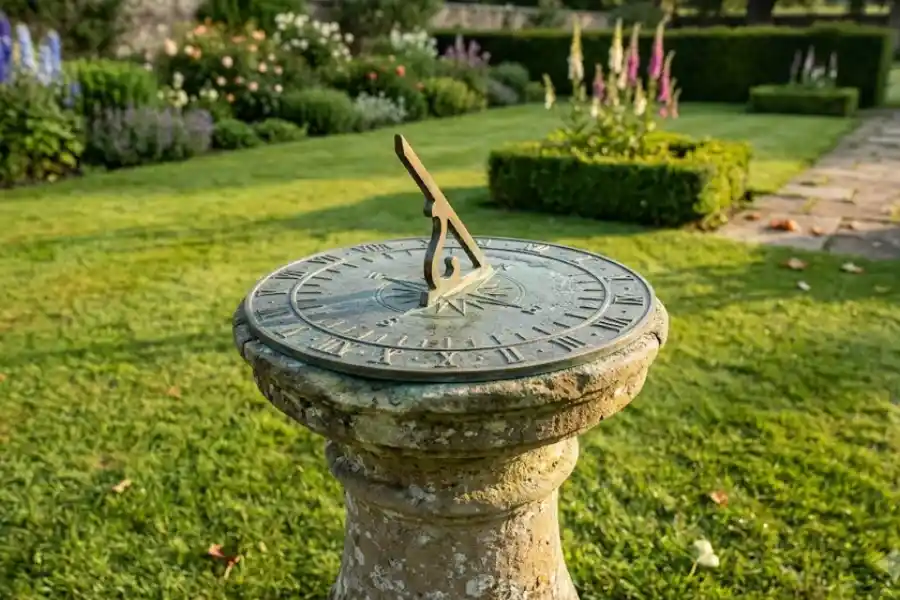
A sundial is a timekeeping tool made of two main parts: a flat, marked dial and a raised piece called the gnomon. As the sun moves across the sky, the gnomon casts a shadow onto the dial. That shadow slowly sweeps across the hour markings, roughly one hour at a time, and gives you a reading of the current time.
The idea is old. The ancient Egyptians built the first shadow clocks around 1500 BCE, and the Greeks and Romans later refined the design into the sundials we recognize today. What started as a serious scientific instrument is now mostly loved for a different reason: it looks stunning in a garden.
Why People Still Buy an Outdoor Sundial Today
Nobody needs a sundial to check the time anymore. Your phone does that better. So why is a sundial for garden spaces still such a popular purchase? A few plain reasons come up again and again:
- It gives a garden a focal point, the same way a fountain or statue does.
- It adds a sense of history and calm to outdoor spaces.
- It works with zero electricity and almost no maintenance.
- It is a favorite gift for anniversaries, retirements, and garden lovers.
- Schools and museums use it to teach kids how the Earth moves.
The kiss of the sun for pardon, the song of the birds for mirth. One is nearer God’s heart in a garden than any place else on earth.
That old garden motto, often engraved right onto sundials, explains the appeal better than any spec sheet could.
Types of Garden Sundials (And Which One Fits Your Space)
Not all sundials work the same way. Before you buy one, it helps to know the main types of garden sundials so you do not end up with the wrong style for your space.
1. Horizontal Sundials
This is the classic style most people picture: a flat dial that sits on a pedestal or a low stone plinth. It needs open ground and works best in the middle of a lawn or flower bed where nothing blocks the sun.
2. Vertical Sundials
These mount flat against a wall or fence, which makes them perfect for smaller gardens, patios, or courtyards that do not have room for a pedestal. The gnomon and markings are angled differently from a horizontal dial, so the two are not interchangeable.
3. Armillary Sundials
Instead of a flat plate, this style uses a ring-shaped frame that represents the Earth’s axis and the celestial sphere. It looks dramatic and sculptural, which is why it is often chosen purely as a piece of garden art rather than a strict timekeeping tool, smaller versions can even serve as a rustic centerpiece for garden table decor.
4. Equatorial Sundials
Less common but worth knowing, this design fixes the dial plate on the same angle as the equator. It is considered the most accurate style by the numbers, though it is harder to find and usually costs more.
Materials: What Your Sundial Is Made Of Matters More Than You Think
The material affects both the price and how long the sundial survives outdoors. Here is a simple breakdown based on how these hold up in real gardens.
- Aluminum or resin (budget range): Light, affordable, fine for a few seasons, but prone to fading and less sturdy in wind.
- Solid brass (mid-range): Naturally resists rust, develops a beautiful green patina over time, and is the most popular choice for serious garden pieces.
- Cast iron (mid to premium): Heavy, extremely durable, and ages into a rustic, weathered look that many gardeners prefer.
- Natural stone (premium): The most traditional and long-lasting option, often hand-carved, and priced accordingly.
As a rough guide, budget sundials run around $20 to $50, mid-range brass or iron pieces sit between $50 and $150, and premium hand-forged or stone sundials can go well past $500 depending on craftsmanship.
How to Set Up a Garden Sundial So It Works
This is the part almost every product listing skips, and it is the single biggest reason people end up disappointed. Follow these steps when you learn how to set up a garden sundial correctly.
Step 1: Find True North, Not Compass North
If you live in the northern hemisphere, the gnomon needs to point toward true north. A regular compass points to magnetic north, which can be off by several degrees depending on where you live. For the most accurate placement, check your local magnetic declination online or use a phone app that shows true north.
Step 2: Pick a Fully Open, Flat Spot
Shade from trees, fences, or buildings at any point during the day will block the shadow and throw off your reading. Choose the sunniest, most open area of your garden, and make sure the base sits level. To make the spot look even more intentional, you can surround the base of the pedestal with decorative personalized garden stones.Even a slight tilt will make the shadow fall in the wrong place.
Step 3: Match the Gnomon Angle to Your Latitude
This is the detail almost nobody mentions. The angle of the gnomon should match the latitude of your location. Near the North Pole, that angle would be close to 90 degrees, while near the equator it flattens out to nearly 0 degrees. A sundial made for London will read incorrectly if it is installed in Miami, because the two cities sit at very different latitudes. Many manufacturers sell sundials pre-set for specific latitude ranges, so check this before buying if accuracy matters to you.
Step 4: Adjust for Daylight Saving Time
A sundial follows solar time, not clock time. During daylight saving months, simply add one hour to whatever the dial shows to match your clock.
How to Read a Sundial the Right Way
Once it is set up correctly, reading it is simple:
- Look at the shadow cast by the gnomon, the raised central piece.
- Use the straight, outer edge of the shadow, not the blurry middle, for the most accurate reading.
- Match where that edge lands on the dial’s hour markings.
- Remember it only works in direct sunlight. Cloudy days and nighttime will give you nothing.
Common Mistakes People Make With a Garden Sundial
Based on patterns seen across hundreds of buyer reviews, the same problems keep showing up. Avoid these and you will save yourself the frustration:
- Buying without checking latitude specs, then wondering why the time reading is consistently wrong.
- Installing near trees or fences that cast shade during key parts of the day.
- Using a compass instead of true north, which throws the whole alignment off.
- Ignoring the base or pedestal, which affects both stability in wind and long-term tilt.
- Skipping weatherproofing checks for cheaper resin models, which can crack or fade within a year or two in harsh climates.
Frequently Asked Questions
Does a garden sundial work on cloudy days?
No. A sundial depends entirely on direct sunlight to cast a shadow, so it will not give a reading on overcast days or after dark.
How accurate is a garden sundial really?
A well-placed, properly angled sundial can read within a few minutes of actual clock time. Without correct latitude alignment and true north placement, though, it can be off by 15 minutes or more.
Can I place a sundial on a wall instead of the ground?
Yes, but you need a vertical sundial specifically designed for wall mounting. A horizontal sundial will not read correctly if placed vertically, since the two are built with different angles.
What is the best material for a sundial that stays outside all year?
Solid brass and cast iron are the most popular choices for year-round outdoor use. Both resist rust and weather well, and they look better as they age and develop a natural patina.
Do I need to do anything to maintain a sundial?
Very little. An occasional wipe down and making sure the base has not shifted or tilted is usually all that is needed, especially with brass or cast iron models.
Final Thought
A garden sundial is one of the rare outdoor pieces that gives you both function and beauty, as long as it is set up with a little care. Get the placement, angle, and material right, and it will sit in your garden for decades, quietly doing the same job it has done since ancient Egypt, without ever asking for a battery.