Garden Hose Reel Cart: How to Pick One That Won’t Leak
You drag the hose across the lawn, and it snags on a rose bush. It kinks, and the water stops. Then you walk back, fix it, and start over.
Sound familiar? A garden hose reel cart ends that problem. It rolls wherever you go and winds up the hose in just a few minutes. It also keeps the hose off the ground, where it can kink and crack.
Quick answer: For most yards in the US, buy a four-wheel garden hose reel cart with a steel frame, a metal swivel, and a hose feeder. Pick one that is rated for more hose than you own, then follow the care tips below so it can last for many years.
This article helps you choose the right garden hose reel cart. You will see real sizes and real specs, along with the problems that owners complain about most. You will also learn a few things that most reviews skip, like how heavy a full hose can get.
What Is a Garden Hose Reel Cart?
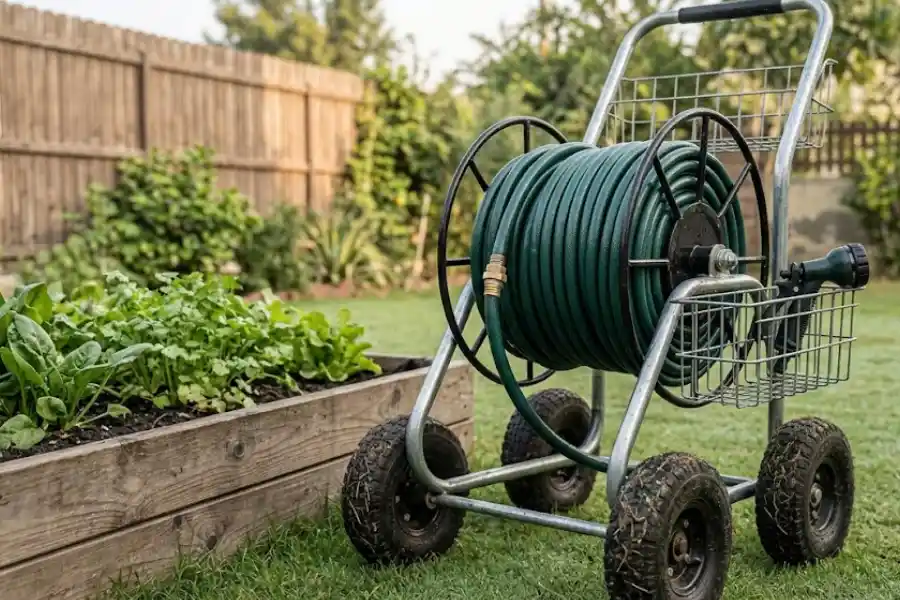
A garden hose reel cart is a hose reel on wheels. You turn a crank to wind the hose onto a drum, and then you pull the cart by its handle like a small wagon.
Most carts come with a short leader hose that is about 4 to 6 feet long. It links your faucet to the reel. Your long hose sits on the drum and connects to the other side, so water flows from the faucet, through the swivel, and out the end of your hose.
Carts usually come in two main styles:
- Two-wheel carts are light and easy to store. You tilt them back to roll them, so you need to balance them.
- Four-wheel carts stand on their own and are easier to pull when the hose is full. They also tip less, which is important on uneven ground.
Is a Garden Hose Reel Cart Better Than a Wall Mount Reel?
It depends on your yard and on how you water. A wall mount reel stays in one spot, so it looks neat and takes no floor space. But your hose can only reach so far from that wall.
A garden hose reel cart is easy to move. You can roll it from the back faucet to the front yard in a minute, and you can park it in a shed for the winter.
- Pick a garden hose reel cart if you have a long hose, a big yard, or more than one faucet.
- Pick a wall mount if your yard is small and you mostly use one faucet.
- Pick a hose box if you want to hide the hose from view, or a decorative garden hose holder if you want it to look nice on display.
How Much Hose Can a Garden Hose Reel Cart Hold?
This is the first number to check, and it is the one that people get wrong most often.
Makers list capacity by hose width, so a cart that holds 300 feet of 5/8 inch hose will hold more of a thinner hose and less of a thicker one. Here are some real examples from current listings:
- One four-wheel cart lists 330 feet of 5/8 inch hose, or 400 feet of 1/2 inch hose.
- Another lists 230 feet of 5/8 inch hose, or 300 feet of 1/2 inch hose.
- The Liberty Garden 871-S holds 250 feet of 5/8 inch hose.
- Compact carts, like the Suncast Hosemobile, the Yardworks cart, and the ReelEasy cart, hold about 175 feet of 5/8 inch hose.
Now here is a simple rule: pick a garden hose reel cart that holds about 20 percent more than your hose. Capacity numbers show the most the drum can take, and they assume the hose is wound flat and neat. In real life, the hose is often not wound that neatly. A thick or stiff hose also takes up more room, so it can fill the drum sooner than the label says.
Check your hose width too, because most home hoses are 5/8 inch, but heavy-duty hoses are often 3/4 inch. That thicker hose takes more space, so it will not reach the number on the box.
The Hidden Problem: A Full Hose Is Heavy
Here is something that most product pages skip: water has weight, and it adds up quickly.
A 100 foot hose with a 5/8 inch width holds about 13 pounds of water. A 200 foot hose holds about 27 pounds. That is before you add the weight of the hose itself.
So drain the hose before you wind it. Turn off the faucet and open the nozzle, then walk the hose back and let the water run out. Your garden hose reel cart will roll with less effort. The frame and the swivel will also last longer.
Weight matters for the cart too. In its tests of 15 hose reels, HGTV liked a light aluminum cart that weighs under nine pounds, and its kickstand helped keep it steady. A light cart is easy to lift up steps. A heavier steel cart is often more stable on a slope.
7 Features That Matter Most in a Garden Hose Reel Cart
1. Frame Material and Steel Thickness
Steel frames are strong, while plastic frames are light and do not rust. Both can work well, but steel usually handles a heavy load better.
If you see the word “gauge,” keep this in mind. A lower gauge number means thicker steel, so a 13 gauge frame is thicker than a 16 gauge frame. The Liberty Garden 871-S uses 13 gauge steel.
A powder coat finish helps stop rust, so check the frame for scratches when the box arrives. Liberty Garden says in its manual that fixing scratches helps slow rust.
2. Tires: Air-Filled or Flat-Free
Wheels matter more than you think. A full hose is heavy, and the cart must roll over grass, gravel, and bumps.
- Air-filled tires give a soft ride and roll well on soft ground, but they can go flat.
- Solid tires never go flat and need no pump, but the ride is firmer.
Bigger wheels roll over bumps with less fuss, and many large carts use 10 inch wheels. Compact carts often use 6 inch wheels.
If you pick air-filled tires, read the manual first. Liberty Garden says to use a hand pump only. For its Model 871, the top limit is 15 PSI. Never use a compressor, and never go over the number on the tire or in the manual.
3. A Hose Feeder
A hose feeder moves the hose from side to side as you wind. This helps the hose lay flat on the drum. Without a feeder, the hose piles up in one spot and tangles.
Some carts have a slide feeder, while others, like the Liberty Garden 871-S, have no automatic feeder. On those, you steer the hose by hand.
4. The Swivel and Leader Hose
This is where most leaks start. The swivel lets the drum spin while water flows in, so if it fails, water sprays out of the reel.
Look for a metal water path, such as brass or aluminum, because brass holds up better than cheap plastic. The ReelEasy cart, for one, uses an aluminum water system. Also check that the leader hose is long enough to reach your faucet.
5. A Handle You Can Live With
You will grip this handle every time you move the cart, so a foam grip feels better in your hand. A foldable handle also saves room in a shed. The Yardworks and ReelEasy carts both list a foldable handle.
6. A Basket or Hook
A basket holds your nozzle, gloves, and spray gun, and a hook holds a sprinkler or a hose tool. These are small things, but you will use them every time.
7. Balance on Uneven Ground
Hose pulls can push a cart over, and a raised center of gravity makes it worse. One maker warns not to pull its cart over steep or uneven ground. If your yard has a slope, pick a four-wheel cart with a wide base.
Real Garden Hose Reel Cart Models to Compare
Here are real carts, with the specs makers and sellers list. Use them to see what each size looks like. Models and prices change, so check the seller page before you buy.
Compact Picks (About 175 Feet)
The Suncast Hosemobile 175 ft cart, the Yardworks 175 ft cart, and the ReelEasy foldable cart all fit here. GardeningEtc named the Suncast Hosemobile its pick for easy use.
The Yardworks cart lists a hose feeder, a foldable handle, and a 6 foot leader hose. The ReelEasy lists 6 inch wheels, a 4 foot leader hose, and a foldable handle. These models usually suit small and mid-size yards, or a patio with a container garden.
Mid-Size Pick (About 250 Feet)
The Liberty Garden 871-S is a four-wheel garden hose reel cart with a 1-1/2 inch steel frame. It holds 250 feet of 5/8 inch hose. It comes with a 5 foot leader hose, brass and galvanized fittings, and a powder coat finish. It was listed at $169.99 at Ace Hardware.
Large-Yard Picks (300 Feet and Up)
GardeningEtc picked the Liberty Garden 880-2 as a top choice for big yards, and it has a basket for tools. Many budget carts also list 300 feet or more. One example is a Costway cart that holds 330 feet of 5/8 inch hose. It has four 10 inch solid wheels, a metal frame, and a 6 foot inlet hose with a brass fitting.
Be careful with the cheapest big carts. Many sit between 3.6 and 3.8 stars out of 5 on big retail sites. Buyer reviews on some mention leaks at the swivel and parts that come loose. A strong swivel matters more than a big number on the box.
Common Garden Hose Reel Cart Problems and Easy Fixes
Water Leaks at the Swivel
This is the most common complaint among owners. Most leaks come from a loose part, a missing washer, or a worn o-ring. First, check that the rubber washer sits inside the hose nut. and then tighten it by hand. Do not over-tighten, because Liberty Garden warns that too much force can damage the parts.
Still leaking? Look at the o-rings, because Hoselink notes that its o-rings are size specific, so you need the exact part from the maker.
The Hose Piles Up or Tangles
Hold the hose a few feet from the reel as you wind, and keep a little tension on it. Steer it from side to side by hand if the cart has no feeder. If your cart has a feeder arm, make sure it is set up right.
The Cart Tips Over
Pull the hose straight out from the front of the reel, not from the side, because side pulls push the cart over. Use it on flat ground, and drain the hose before you move it.
Rust Spots
Park the cart on hard ground, such as a paver patio, not in wet grass. Rinse off dirt, and touch up scratches in the paint as soon as you see them.
A Flat Tire
If your cart has air-filled tires, check them each spring. Fill them with a hand pump to the PSI on the tire. If you hate this job, buy a cart with solid tires.
How to Use Your Garden Hose Reel Cart, Step by Step
- Set the cart on flat ground near your faucet.
- Screw the leader hose onto the faucet and the reel, check that each washer is in place, and tighten by hand.
- Walk the hose out to your work area. Pull it straight, not from the side.
- Turn the water on slowly, and look for drips at the swivel.
- When you are done, turn off the faucet.
- Open the nozzle to let the pressure out, and let the hose drain.
- Wind the hose with the crank, and steer it from side to side with light tension.
- Store the cart in the shade or in a shed. Sun can wear down a hose over time.
How to Protect Your Garden Hose Reel Cart in Winter
Frozen water expands, and it can crack a swivel, a fitting, or the hose. A few simple steps can protect your cart from that damage.
- Unhook the leader hose from the faucet before the first hard freeze.
- Drain all the water from the hose and the reel.
- Wind the hose up and roll the cart into a garage or shed.
- If it must stay outside, cover it and keep it off wet ground.
How This Article Was Researched
This article draws on maker manuals, support pages, seller listings, and expert reviews. That includes the Liberty Garden care manual, the Hoselink troubleshooting page, and product pages from Ace Hardware and Best Buy. It also includes hose reel reviews from GardeningEtc and HGTV.
Where a number comes from a maker, it is the maker’s claim, and specs, prices, and stock change often. Always check the seller page before you buy. The tips on draining, winding, and winter care come from the maker manuals and from basic physics, like the weight of water.
Frequently Asked Questions
How much does a garden hose reel cart cost?
Most carts in current listings run from about $80 to $180. Basic two-wheel carts usually cost less, while large four-wheel steel carts cost more. A pricey cart is not always better than a cheap one. Look at the swivel, the tires, and the frame, and not only the price tag.
Can I leave a garden hose reel cart outside?
Yes, in warm months, but park it on hard ground in the shade. Sun and wet grass wear it down faster. In winter, drain it and store it inside.
Are four wheels better than two?
For most people, yes. Four wheels stand on their own, tip less, and carry a full hose with less effort. Two-wheel carts are lighter and easier to store. They suit small yards.
What size garden hose reel cart do I need?
Measure your hose, then pick a cart that holds about 20 percent more. For a 100 foot hose, look for a cart rated for 125 feet or more. Most compact carts hold 175 feet of 5/8 inch hose, which is plenty for a small yard or a few raised garden beds. For 200 feet or more, go with a four-wheel cart.
Does a garden hose reel cart work with a 3/4 inch hose?
Yes, but it holds less, because a 3/4 inch hose is thicker and fills the drum faster. Check the label, and if it lists only 5/8 inch and 1/2 inch sizes, ask the seller before you buy.
Should I leave the water on while I wind the hose?
No. Turn off the faucet and let the water drain first, because a hose under pressure is stiff and hard to wind neatly. A full hose is also much heavier to handle.
Final Thoughts
A good garden hose reel cart saves you time every week. It keeps your hose neat, protects it from kinks, and takes the hard work out of watering.
Match the size to your hose and your yard. Check the swivel, the tires, and the frame. Always drain the hose before you wind it. Do those things, and your garden hose reel cart can last for many seasons.
Ready to choose? Start with your hose length, then pick the type that fits your yard. The tips above will help with the rest.