4×8 Raised Garden Bed Planting Layout: 3 Plans, Plant Counts
You have 32 square feet of fresh soil and a pile of seed packets. Now comes the hard part. What goes where?
Plant too close, and the plants fight for light. Plant too far apart, and you waste space. Put a tall tomato on the wrong side, and your lettuce sits in shade all summer.
A smart 4×8 raised garden bed planting layout fixes all three problems. In this article, you get three plans you can copy right now. Each one lists the exact number of plants for every square. You will also learn how to keep the bed full from early spring to late fall.
The Quick Answer: The Best 4×8 Raised Garden Bed Planting Layout
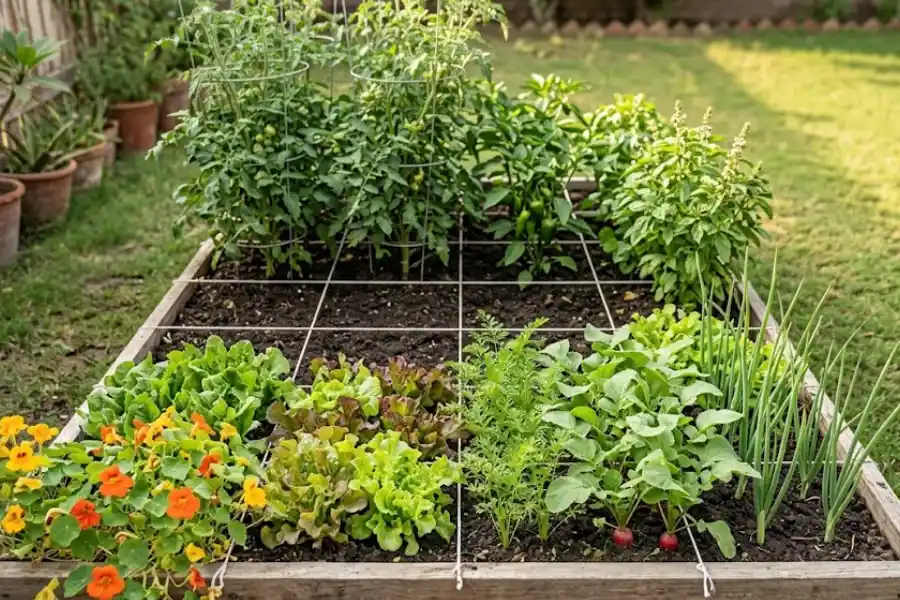
The best 4×8 raised garden bed planting layout follows one simple rule. Tall plants go on the north side. Short plants go on the south side. Climbers go on a trellis along the north edge.
Next, split the bed into 32 squares that are each one foot by one foot. Give every crop a set number of squares. Then plant by the numbers. That means 4 lettuce, 9 bush beans, or 16 carrots in each square.
Before You Plant: 5 Checks for Any 4×8 Raised Garden Bed Planting Layout
- Sun. Most vegetables need 6 to 8 hours of full sun a day. Watch your bed for one day and note any shady spots.
- Direction. Find north. Tall crops and trellises go on that side, so their shade falls outside the bed. If your bed runs north to south, put the tall crops at the north end.
- Depth. Aim for 12 inches of soil or more. The Old Farmer’s Almanac calls 12 to 18 inches ideal. Fill the bed with a rich, well-draining mix.
- Reach. A bed that is 4 feet wide lets you reach the middle from either side. You never need to step on the soil.
- Grid. Use string or thin wood strips to mark 32 one-foot squares. A grid keeps you from overplanting.
How Many Plants Fit in One Square?
Every 4×8 raised garden bed planting layout in this article uses the square foot method, which Mel Bartholomew made popular. You split the bed into one-foot squares. Small plants get more plants per square. Big plants get fewer. Here are the counts used in every plan below.
- 1 plant per square: peppers, cucumbers, and nasturtiums.
- 2 plants per square: basil.
- 4 plants per square: lettuce, cilantro, and marigolds.
- 8 plants per square: pole beans on a trellis.
- 9 plants per square: bush beans, spinach, onions, and beets.
- 16 plants per square: carrots, radishes, green onions, and garlic.
- 4 squares per plant: tomatoes and zucchini.
Tomato tip: Many charts say one tomato per square. That is very tight. Give each caged tomato a 2×2 foot block, which is 4 squares. More air around the leaves helps stop disease.
These numbers match the UC Cooperative Extension spacing chart and the Phipps Conservatory chart. Your seed packet has the final word, so check it for your variety.
Layout 1: The Salad and Sauce Bed (Best for Beginners)
This 4×8 raised garden bed planting layout grows what most people buy every week. Think tomatoes, peppers, beans, lettuce, and carrots. It is easy and forgiving, so start here if this is your first bed.
Back Half (North Side, 16 Squares)
- 2 caged tomatoes: 4 squares each, or 8 squares in all. Put one at each end.
- 2 pepper plants: 1 square each.
- Basil: 2 squares, with 2 plants in each. Basil does well next to tomatoes.
- Marigolds: 1 square with 4 plants. They draw pollinators and help with pests.
- Bush beans: 3 squares, with 9 plants in each. That makes 27 plants.
Front Half (South Side, 16 Squares)
- Leaf lettuce: 4 squares, with 4 plants in each. That makes 16 plants.
- Carrots: 3 squares, with 16 in each. That makes 48 plants.
- Radishes: 1 square with 16 plants.
- Green onions: 2 squares, with 16 in each. That makes 32 plants.
- Spinach: 2 squares, with 9 in each. That makes 18 plants.
- Beets: 2 squares, with 9 in each. That makes 18 plants.
- Nasturtiums: 2 squares, with 1 plant in each. Set them at the front corners so they can spill over the edge.
This plan holds about 190 plants. Lettuce, spinach, and radishes like cool weather. They finish first, which leaves room for a second crop. Use this 4×8 raised garden bed planting layout as your base, then swap in the crops your family eats most.
Layout 2: The Family Harvest Bed (Grow Up, Not Out)
This 4×8 raised garden bed planting layout uses height to grow more food. A garden trellis along the north edge holds beans and cucumbers. That frees up soil for other crops, and it makes picking easy.
Back Half (North Side, 16 Squares)
- Pole beans on the trellis: 4 squares, with 8 plants in each. That makes 32 plants.
- Cucumbers on the trellis: 2 squares, with 1 plant in each.
- 2 caged tomatoes: one cherry type and one slicing type. Each gets 4 squares.
- 2 pepper plants: one hot and one sweet. Each gets 1 square.
Front Half (South Side, 16 Squares)
- Carrots: 3 squares, with 16 in each. That makes 48 plants.
- Green onions: 2 squares, with 16 in each. That makes 32 plants.
- Beets: 2 squares, with 9 in each. That makes 18 plants.
- Radishes: 1 square with 16 plants.
- 1 compact zucchini: 4 squares in one front corner. Let the vines spill over the side.
- Leaf lettuce: 2 squares, with 4 in each. The big zucchini leaves can give it some shade as summer heats up.
- Marigolds: 1 square with 4 plants.
- Nasturtium: 1 square with 1 plant.
This plan holds about 165 plants. Pick compact squash. A full-size vine can take over the whole bed, and it will shade everything near it.
Layout 3: The Salsa Bed
Love fresh salsa? This 4×8 raised garden bed planting layout puts every main ingredient in one bed. You get tomatoes, peppers, onions, cilantro, and garlic.
Back Half (North Side, 16 Squares)
- 3 caged tomatoes: 4 squares each, or 12 squares in all. Mix paste and slicing types.
- 4 pepper plants: 1 square each. Pick a mix of hot and mild.
Front Half (South Side, 16 Squares)
- Onions: 4 squares, with 9 in each. That makes 36 plants.
- Green onions: 2 squares, with 16 in each. That makes 32 plants.
- Cilantro: 4 squares, with 4 in each. That makes 16 plants.
- Garlic: 2 squares, with 16 in each. That makes 32 plants.
- Marigolds: 2 squares, with 4 in each. That makes 8 plants.
- Nasturtiums: 2 squares, with 1 plant in each.
Two quick notes. Garlic goes in during fall, and it stays until summer. Those squares stay busy for months. Cilantro bolts in hot weather, so sow a new square every few weeks, or grow a backup batch in outdoor herb pots. Tomatoes and peppers love heat, so this 4×8 raised garden bed planting layout works best in your sunniest spot.
Keep Every Square Working: A Spring-to-Fall Plan
A full bed in May feels great. But a good 4×8 raised garden bed planting layout keeps working after that. When a crop ends, add a handful of compost and plant something new.
- Early spring: Plant cool-season crops in the front half. Think lettuce, spinach, radishes, and onions.
- After the last frost: Plant warm-season crops in the back half. Tomatoes, peppers, basil, cucumbers, and beans go in now.
- Early summer: When radishes and spinach finish, refill those squares with bush beans or carrots.
- Late summer: Sow lettuce, spinach, radishes, or kale for a fall harvest.
- Fall: Plant garlic. You will pull it next summer.
Planting dates change from place to place. Ask your local extension office for your last frost date. Then count from there.
5 Mistakes That Ruin a 4×8 Raised Garden Bed Planting Layout
- Tall plants on the south side. Savvy Gardening shared a good lesson here. Zinnias that grow 3 to 4 feet tall cast shade on the veggies behind them. Keep tall plants on the north side.
- Crowded tomatoes. Tight plants hold moisture around their leaves, which makes it easier for disease to spread. Give each tomato 4 squares, and thin plants as they grow.
- Vines that take over. Squash and melons can fill a whole bed. Choose compact types. Plant them near an edge, or train them up a trellis.
- Same crop, same spot, every year. Tomatoes and peppers are in the same plant family. Move them to a new spot each year to cut down on soil disease.
- Empty squares. A bare square is wasted space. Use the spring-to-fall plan above and replant as soon as you harvest.
Care Tips for Your 4×8 Raised Garden Bed Planting Layout
- Water evenly. Keep the soil evenly moist, and pay extra attention when plants are young and their roots are small.
- Add compost. Mix in a trowel of compost each time you replant a square.
- Harvest often. Picking beans and greens often keeps them producing.
- Take notes. Write down what worked, and use plant markers so you remember what went where. Next year, you can fix what did not.
Frequently Asked Questions
How many plants fit in a 4×8 raised bed?
It depends on the crops and your method. Row-style plans, like the Almanac’s beginner plan, hold about 40 to 50 plants. Square foot plans hold far more, because carrots and radishes take little room. Each 4×8 raised garden bed planting layout above holds about 130 to 190 plants.
What is the best 4×8 raised garden bed planting layout for beginners?
Start with the Salad and Sauce Bed. It uses easy crops that most people already know how to cook and eat. Each crop also has a clear spot, so there is little guesswork.
Can I swap crops in a 4×8 raised garden bed planting layout?
Yes. Trade one crop for another with the same height, the same water needs, and the same number of squares. For example, swap kale for spinach, or a second pepper for a second tomato. Keep tall plants on the north side.
Is a 4×8 raised bed big enough for a family?
It gives you 32 square feet. That is enough for steady harvests of greens, roots, beans, and onions. It will not grow everything a family eats, so many gardeners add a second bed later. Have less space? A 3×3 garden is another way to start small.
Which way should a 4×8 raised bed face?
Run the long side from east to west. Then the north side is your back. Tall crops and trellises go there.
How much soil does a 4×8 raised bed need?
Aim for 12 inches or more. Some gardeners grow many crops in just 6 to 8 inches of mix. But extra soil gives carrots, beets, and tomatoes more room to root.
Can I use the same layout in the ground?
Yes. Measure a 4×8 foot spot in your yard and use the same spacing. A raised bed mainly helps with drainage and easy care.
Final Thoughts
Pick one plan and mark your grid. Plant the back half first, then the front. Your 4×8 raised garden bed planting layout does not need to be perfect. It just needs a plan.
Take a photo each month and jot down notes about what grew well and what struggled. By next season, you will know how to make your own 4×8 raised garden bed planting layout even better.