
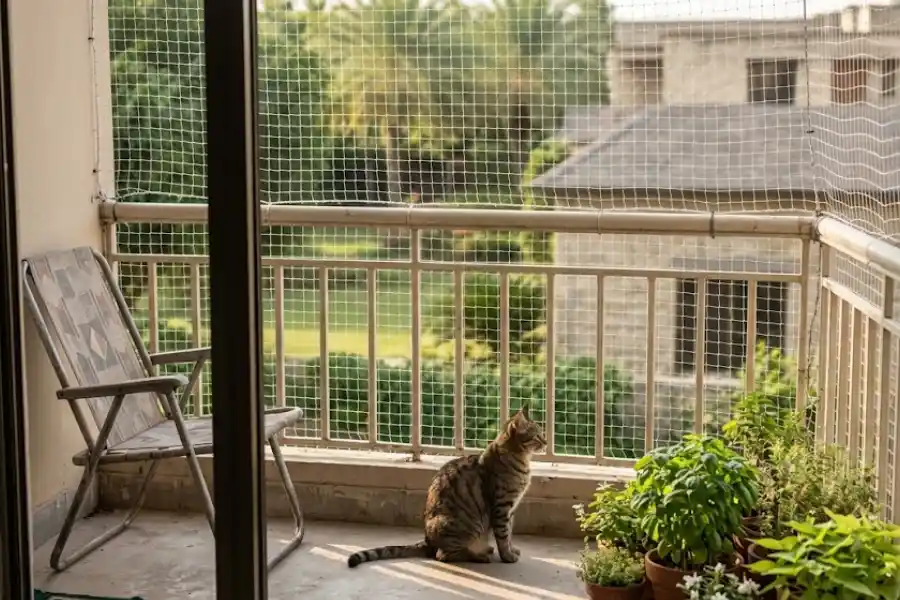
Balcony Netting for Cats: The Safe Way to Let Them Outside
Every summer, vet clinics see a rise in cats brought in after falling from balconies and open windows. It happens more than most cat owners realize. A cat spots a bird, leans a little too far, and gravity takes over. This is called high-rise syndrome, and it’s a big reason so many cat owners no longer treat balcony netting as optional.
The good news is that most cats survive these falls. But survive does not mean unharmed. Many cats end up with broken jaws, fractured legs, or bruised lungs. Vet bills for these injuries can run into the thousands. A simple net costs a fraction of that and stops the fall from ever happening.
This article walks you through why balcony netting for cats matters, how to pick the right one, how to install it (even if you rent and cannot drill), and the mistakes that leave cats at risk even after the net goes up.
Why Balcony Netting for Cats Actually Matters
Cats are confident climbers, but they are not fall-proof. Their balance is excellent, not perfect. A gust of wind, a slippery railing, or a sudden jump for a bug can send a cat over the edge before they even realize what happened. This is a risk specific to elevated outdoor spaces, so if you are not sure whether the space you are protecting is really a balcony or something closer to ground level, our terrace vs balcony guide can help you tell the two apart before you plan your netting.
Research backs this up. One large veterinary study found that falls are more common in warm months, and that most injured cats are young, under three years old, and full of curiosity. According to PetMD, around 90 percent of cats survive a high-rise fall when they reach a vet quickly, but nearly a third of those cats need serious medical care to make it. Without that care, the odds drop fast.
A cat does not need to fall from a high floor to get hurt. Even a second or third-story fall can cause broken bones and internal injuries.
Balcony netting for cats solves this problem at the source. It does not stop your cat from enjoying fresh air, sunbeams, or watching birds. It just removes the chance of a fall turning into an emergency. In fact, once the net is up, it is the perfect time to add a best bird feeder for apartment balcony setup just outside the railing, so your cat gets a front-row view, safely, from behind the mesh.
Balcony Netting vs. Other Cat-Proofing Options
Netting is not the only way to protect a cat on a balcony, but it is usually the easiest and cheapest. Here is how it compares to the other common options.
- Cat netting: Flexible mesh that covers the full railing area. Cheap, easy to install, and available in transparent styles that barely change how your balcony looks.
- Rigid mesh panels: Stiffer than netting and good for balconies with wide railing gaps. They take more effort to fit and usually cost more.
- Railing or banister guards: These only cover gaps between railing bars. They stop a cat from squeezing through, but they will not stop a cat from climbing over the top.
- Catios (enclosed cat patios): A fully enclosed space built onto the balcony. It is the safest option by far, but also the most expensive and the most work to build.
For most apartment and condo owners, balcony netting hits the sweet spot between safety, cost, and how easy it is to set up.
How to Choose the Right Balcony Netting for Your Cat
Mesh Size
This matters more than most people think. If the holes are too big, a kitten or slim cat can squeeze a head or paw through and get stuck. Look for a mesh size around one to two inches. Small enough to stop a paw, small enough to stop a head, but still see-through.
Material
Most cat netting is made from nylon, sometimes reinforced with thin steel wire for extra strength. Steel-wire reinforced netting resists chewing and clawing better, which matters if your cat likes to test things with its teeth. Plain nylon is lighter and cheaper, and works fine for calmer cats.
Transparency
If you want to keep your view, choose a transparent or light-colored net. Black netting blends in against dark railings but stands out against light walls or white railings.
Weather and UV Resistance
Sun and rain break down cheap netting fast. Look for netting labeled UV-resistant and weatherproof. This keeps it from turning brittle and cracking after a season outdoors.
Size
Measure the full width of your balcony, plus the height from the floor to at least 12 inches above the top of the railing. That extra height stops a determined cat from simply climbing over the top edge. This is also a good moment to think through furniture and planter placement, since our guide on how to make a small balcony garden for beginners covers the basics, and where things end up sitting can change exactly where the netting needs to run.
How to Install Balcony Netting Without Drilling (Great for Renters)
If you rent your home, drilling into the railing or wall is usually not an option. Luckily, there are no-drill methods that work just as well.
- Measure your balcony’s width, height, and any side sections that need covering.
- Buy netting that is slightly larger than your measurements, so you have room to adjust.
- Use adhesive hooks, tension rods, or clamp-style brackets that grip the railing instead of drilling into it.
- Attach the top edge of the net first, keeping it as straight and tight as possible.
- Pull the netting down and secure the bottom edge to the base of the railing using cable ties or clips.
- Secure both side edges the same way, checking for any gaps a paw could push through.
- Push and tug on the finished net to test its strength before letting your cat near it unsupervised.
How to Install Balcony Netting With Drilling (For a Permanent Setup)
If you own your home, or your landlord allows it, a drilled installation lasts longer and holds up better in wind.
- Mark screw or hook locations every 6 to 12 inches along the top, bottom, and sides of the balcony frame.
- Drill pilot holes at each marked spot.
- Screw in sturdy eye hooks or anchors at each point.
- Attach the netting to the top row of hooks first, keeping the tension even.
- Work your way down and across, securing the net to every hook with cable ties or strong twine.
- Trim off any extra netting, but leave a little slack rather than pulling it too tight.
- Inspect every edge for gaps, then test the whole setup before trusting it with your cat.
7 Mistakes People Make When Netting a Balcony for Cats
A poorly installed net can give a false sense of safety. These are the mistakes that cause the most trouble.
- Skipping accurate measurements. Gaps at the corners are the most common escape point.
- Choosing mesh that is too large. Kittens and slim cats can slip through or get their heads stuck.
- Leaving a gap at the bottom. Cats will find and use any opening near the floor.
- Using weak anchor points. Cheap hooks or thin adhesive strips can pull loose after weeks of wind and weight.
- Forgetting the “overhang” rule. Netting that stops exactly at railing height gives an athletic cat something to climb over.
- Never checking for wear. Sun, rain, and scratching all weaken netting slowly over time.
- Trusting it without testing. Always push, pull, and watch your cat’s first few visits before leaving them unsupervised.
Maintaining Your Balcony Net Over Time
Balcony netting is not a one-time job. It needs a quick check every month or so, especially after storms or extreme heat. This matters even more if you are growing an herb garden on a balcony, since trailing stems and leaves near the railing can quietly press against the mesh and stretch small gaps open over time.
- Look for fraying, cracked wire, or thinning nylon fibers.
- Check that anchor points and hooks are still tight.
- Watch for claw marks that may have weakened a section.
- Re-tension the net if it has started to sag.
- Replace the netting every few years, or sooner if it shows heavy wear.
Frequently Asked Questions
Does balcony netting block the view?
Not if you choose a transparent or light-colored net. Many cat owners say they forget it is even there after a few days.
Can I still open my balcony door with netting installed?
Yes. Most netting installations leave the door and its frame free, so you can open and close it normally. The net covers the open railing area, not the doorway itself.
Will my landlord allow balcony netting?
Many landlords are fine with no-drill netting since it leaves no permanent marks. Always check your lease or ask first, especially if you are considering a drilled installation.
How much does balcony netting cost?
Basic nylon netting for a standard balcony often costs less than a single vet visit for a fall injury. Steel-wire reinforced or custom-cut netting costs more but lasts longer and holds up better against scratching.
Can kittens use a balcony net safely?
Yes, as long as the mesh size is small enough. Kittens are lighter, more curious, and more likely to test small gaps, so a tighter mesh is worth the extra care.
Is chicken wire a good substitute for cat netting?
It can work in a pinch, but it has sharp edges that can cut a cat’s paws and it rusts over time. Purpose-made cat netting is softer, safer, and built to last outdoors.